
On Braiding
Time, baking, and Boom Town by Sam Anderson

I know, it’s been a while. I’m sorry. After last month’s love letter to the alphabet, I fell into an alphabetic sinkhole while updating the index to The Educator’s Guide to Texas School Law.
“Every pertinent term” is the phrase used by the Chicago Manual of Style to describe what should be included in an index. In a book about public education law, that ranges from “abortion” to “zero tolerance.” To make matters worse, I was wearing old contact lenses the whole time. It felt like the editorial equivalent of cutting through a jungle with a butter knife instead of a machete. I’m grateful to have emerged. Grateful to be forming sentences out of alphabetical order. In the immortal words of Ludwig Wittgenstein, “Hot ziggety!”
First some news:
I was on a podcast! It was so fun to talk with Amanda Quraishi about writing, The Artist’s Way, and making enormous changes in midlife.
My poem, “Recent Events,” was published in the anniversary issue of Pinhole Poetry.
On braiding
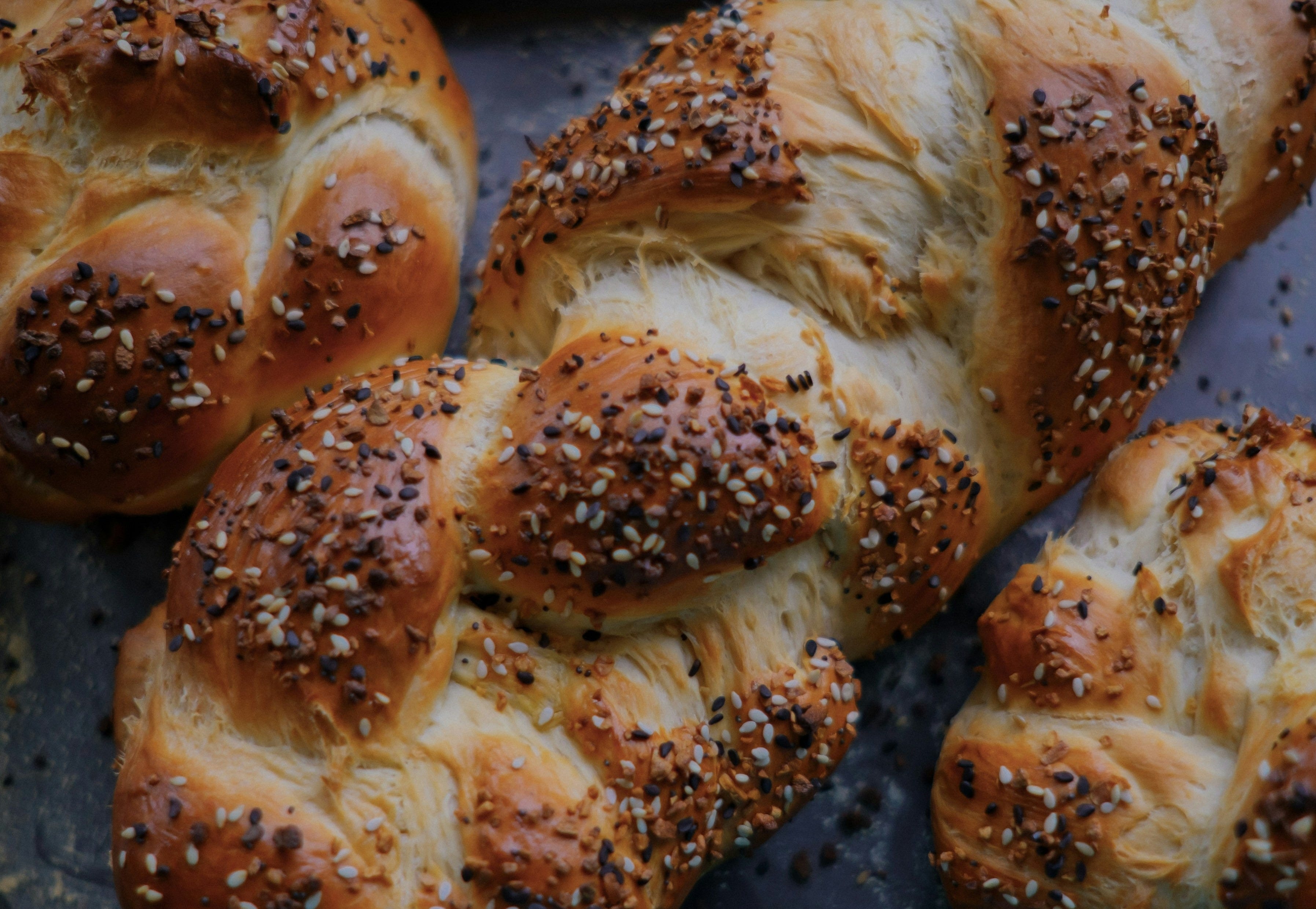
On Fridays, I make challah. The braided dough impresses people. But I’m not an expert baker; I’ve just developed this practice over the years. It’s a matter of showing up every week to do the same thing in more or less the same way. The bread never comes out exactly the same. I control for what I can (the same ingredients, tools, baking time) and try to stay curious.
I’ve been thinking about challah, and braiding, and books. This video might be the reason.
In the video, a wise and benevolent local writer closes her laptop, puts the laptop in an oven, and sets the timer. After a cut, she returns to the oven and pulls out . . . a cardboard box filled with copies of her new book. It is the best cover reveal I’ve ever seen.
But because I take everything literally, the video made me wonder if I’ve been going about writing a memoir all wrong.
What happens to my book while I’m doing other things?
In her essay “On Keeping a Notebook,” Joan Didion wrote:
See enough and write it down, I tell myself, and then some morning when the world seems drained of wonder, some day when I am only going through the motions of doing what I want to do, which is write--on that bankrupt morning I will simply open my notebook and there it will all be, a forgotten account with accumulated interest, paid passage back to the world out there.
Last week, on a bankrupt morning when my eyes and brain were still aching from working on the index, I found this quote in a Word document titled “keep this quote.” It reminded me of all the notebooks on a shelf in my bedroom, all the scraps in the Notes app on my iPhone, all the folders on my computer ambitiously sorted into categories, as if I know from the beginning what an idea is going to grow up to be.
In truth, the more I learn about writing, the more I realize that I need to be patient: to watch the thing as it grows, to listen for what form it wants to take.
Claire Tak, a memoirist on this platform, writes that she has writing “seasons” and writing “moments.”
After giving myself a break from my memoir, it felt like I was falling behind, or like I had given up. But I’ve realized I don’t need to be in a full season to stay connected to writing. I just needed to pay attention and take the moments when they came.
What I’ve found is that those moments still move things forward. Not always in a linear way, but they add up. A Substack post here. A thought there. It’s slower, but it’s not wasted time … You don’t have to be in a full-on writing season to keep going. Pay attention to these moments and take what you can.
My current approach is to write in lists and scraps, as time allows. Add flour, add water, watch it spin. Put the book in a warm and quiet place. Let the book rise. Punch the book down and let it rise again.
Unless it’s unleavened, like the matzah we eat during Passover, making bread involves fermentation. The yeast in my challah dough ferments with the sugars and creates pockets of air. This year I was fortunate to attend a Seder with some professional Jewish bakers. One of them said: “Yeast is all around us, man. It’s in the air.”
After my challah dough has risen a second time, I start braiding. I don’t know the science as well as that baker. But I like to imagine that punching the dough and leaving it alone gives it more heft, more complexity of flavor and texture.
I think of my writing in this way, too.
Of course the Germans have a word for that.
I read a lot of interesting nonfiction books last year, many of which employ a writing method popularly known as braiding. Often, though, I think that writers of “braided” memoirs or essays are employing juxtaposition, like the cinematic technique of montage. While interesting, this form of writing can feel like it’s jumping from thing to thing, without an element that weaves the whole together. These aren’t braids so much as switchbacks.
Perhaps you’ve heard of the German words, Zeitkunst and Raumkunst, meaning, respectively, the art of time and the art of space. Literature, theater, and music are typically thought of as Zeitkunst, unfolding over a period of time. Raumkunst includes visual arts like sculpture, painting, and architecture, in which meaning emerges from the spatial relationship of images.
A lot of recent creative nonfiction seems to exist in a gray area between Zeitkunst and Raumkunst. At worst, writing that relies on juxtaposition can feel random or algorithmic, like Instagram. When it works, as in the grandmother of braided poetic memoir, Maggie Nelson’s Bluets, I suspect that the magic ingredient (the fermentation, if you will), is time.
Poetic memoirs that braid.
Last year, I read many outstanding memoirs and nonfiction books that use some element of braiding. For example:
I’ll Tell You When I’m Home (2025) by Hala Alyan - motherhood/family history/identity
A Truce That Is Not Peace (2025) by Miriam Toews - writing/silence/suicide
Story of a Poem (2023) by Matthew Zapruder - autism/poetry/fatherhood
When they succeed, the common element seems to be a strong organizing strand that propels the reader through the book. These formal elements provide a sense of linear time on the page—which is not the same as moving in chronological order. Zapruder uses the development of a poem. Toews uses her attempts to answer a conference organizer’s question, “Why do you write?” Alyan’s memoir relies on different patterns in different parts of her book: the legend of Scheherezade; a medical form; the countdown to her daughter’s birth.
Boom Town
When I write, I am always trying to connect things. There’s this thing over here, and for some reason it reminds me of this other thing. How are they related? I have to figure it out on the page. I feel this same impulse in Sam Anderson’s Boom Town: The Fantastical Saga of Oklahoma City, Its Chaotic Founding, Its Apocalyptic Weather, Its Purloined Basketball Team, and the Dream of Becoming a World-Class Metropolis.
Anderson had this to say about the genesis of Boom Town:
The pattern for this project was set when, reading a book on my first flight out to OKC, I stumbled across the following sentence about the origin of Oklahoma’s violent weather: “The state is situated in a zone where three climatic regions—humid, sub-humid, and semiarid—meet and mingle.” My mind made a little leap; in the margin I wrote, “Westbrook, Harden, Durant.” That very basic insight—that OKC was a place where powerful forces came together from great distances, creating crises of equilibrium—led to years of further research[.]
My mind made a little leap. Anderson noticed an unlikely connection and then spent years searching for similar patterns. He read books, scoured newspaper archives, watched historical footage on YouTube, interviewed people, and printed out so many documents that his daughter begged him to stop. In other words, a moment of insight plus years of showing up to do the work, over time, led to the only nonfiction book that my brother, father, husband, and I all added to the top of our annual reading list.1
Inspiration, diligence, plus time. Letting that yeast that’s in the air “all around us” do its job.
How did Anderson combine basketball, severe weather, and the history of OKC into one book? That’s where the braiding comes in. Boom Town is a reminder that, while braided memoirs go in and out of fashion, the best writers of nonfiction have been quietly, expertly plaiting themes, narratives, research, and ideas for decades. If you don’t believe me, please get yourself immediately to some John McPhee.
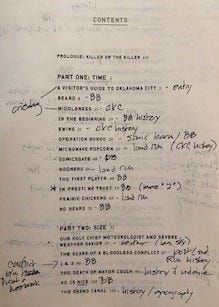
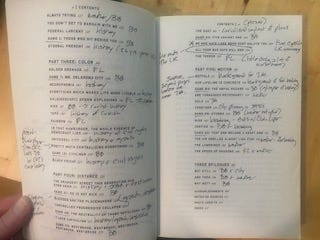
I would like to write a book that weaves different strands as skillfully as Boom Town, so I am studying how it is put together. You can do this too! Here is a picture of my notes in the table of contents. By jotting down which topics I see repeating in each section of the book, I get an idea of how Anderson approached the structure of his book.
Other interesting things
Over at Writing in the Dark, Jeannette Ouellette has created a masterclass on the braided essay. I highly recommend!
I am reading the new Tana French novel, and if you’re looking for a primer on my favorite Irish author of literary crime and mystery, look no further. I’ve got you!
We’re all sick of news articles that read like The Onion, but this New York Times piece about the Texan FEMA official who says he was teleported to a Waffle House in Georgia is a stellar piece of journalism.
I loved reading about Elizabeth Egan’s experience with a new kind of book club even before friend of the ‘stack Griffin Hansbury showed up.
This is a very good Reddit thread.
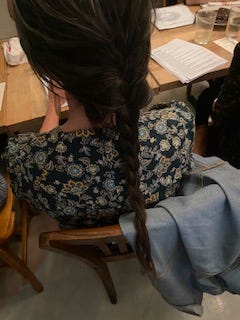
Before I became a mother, I was afraid of having a daughter because I never learned how to braid hair. I didn’t account for the braiding gene skipping a generation; you don’t notice these things until you’re the middle strand. My mother taught my daughter to braid. Now my teenage daughter braids all the hair on her rowing team. She’ll braid my hair, too, if I ask nicely.
This happened once before with a novel, The Five Decembers by James Kestrel.